Inverse of a Function
Digital Handwritten Lesson

Inverse Functions
Understanding Inverse Functions
Real-world applications, definitions, and worked examples with step-by-step solutions
Consider two airlines flying between Pokhara and Kathmandu:
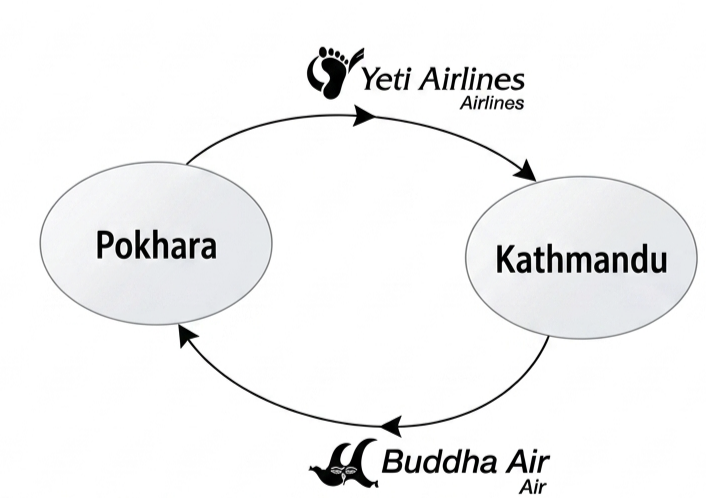
- Yeti Air carries a person from Pokhara to Kathmandu
- Buddha Air carries a person from Kathmandu to Pokhara
- Buddha Air acts opposite to Yeti Air
- Whatever work is done by Yeti Air is undone by Buddha Air
Consider two function machines with input $x = 3$:
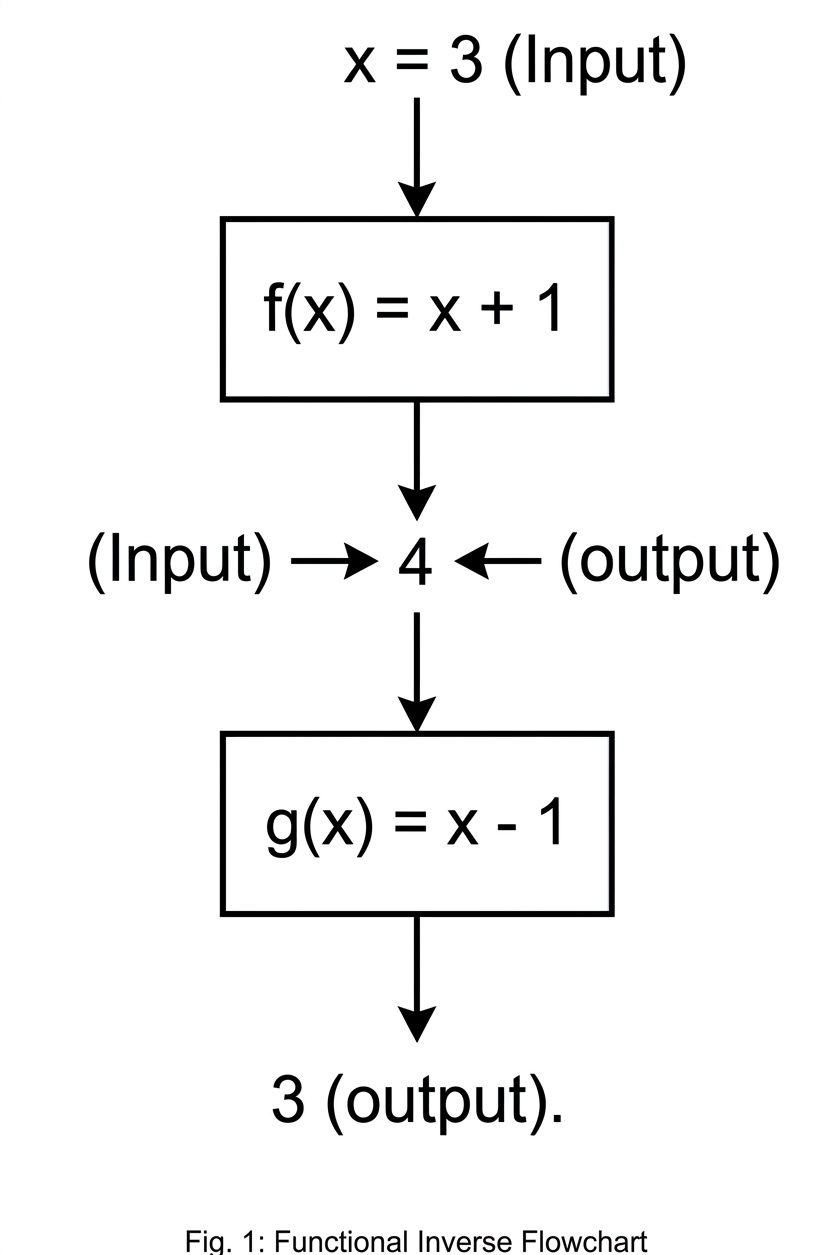
- $f(3) = 4$
- $g(4) = 3$
- The action of $f$ is undone/reversed by $g$
Formal Definition
Inverse Function
Worked Examples
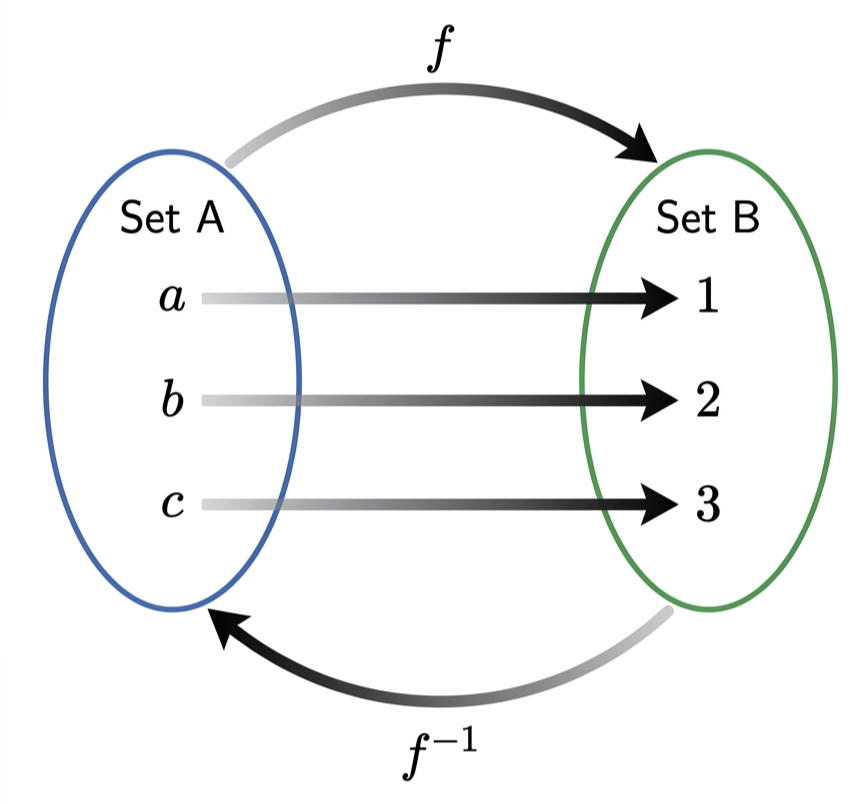
Find $f^{-1}$ if $f = \{(a,1),\,(b,2),\,(c,3)\}$
Solution:
To find the inverse, swap every ordered pair $(x, y) \to (y, x)$:
Find $f^{-1}(x)$ if $f(x) = 2x + 3$
Solution:
Replace every $x$ with $y$ and every $y$ with $x$:
$$x = 2y + 3$$Verification (Checking):
We verify by computing $f \circ f^{-1}(x)$:
Why Does This Method Work?
Mathematical Reasoning:
If $y = f(x)$, then interchanging $x$ and $y$ gives us $x = f(y)$.
When we apply $f^{-1}$ to both sides:
This works because the composite of a function and its inverse is the identity function, so $f^{-1}(f(y)) = y$.
Key Takeaways
- Inverse Concept: An inverse function reverses or "undoes" the action of the original function.
- Existence Condition: Inverses exist only for bijective functions (one-to-one and onto).
- Composition Property: $f(f^{-1}(x)) = f^{-1}(f(x)) = x$ (identity property).
- Finding Inverses: To find $f^{-1}(x)$, replace $f(x)$ with $y$, swap $x$ and $y$, then solve for $y$.
- Verification: Always verify your inverse by checking that the composition equals the identity function.
Course material curated by Mr. Nripendraswar Acharya