Relation
Digital Handwritten Lesson
Relation
Unit: Algebra
Let us consider two non-empty sets:
Find the Cartesian Product \( A \times B \):
Selection – Form sub-collections:
- 1. Collect ordered pairs where \(x = y\), name it \(R_1\):
\( R_1 = \{(1,1),\;(2,2)\} \) - 2. Collect ordered pairs where \(x > y\), name it \(R_2\):
\( R_2 = \{(2,1),\;(3,1),\;(3,2)\} \) - 3. Collect ordered pairs where \(x < y\), name it \(R_3\):
\( R_3 = \{(1,2)\} \)
Looking at our sub-collections, we can see that:
- \(R_1,\; R_2,\; R_3\) are collections of ordered pairs.
- \(R_1 \subset A \times B\)
- \(R_2 \subset A \times B\)
- \(R_3 \subset A \times B\)
Such a collection of ordered pairs \((x, y)\) where \(x\) and \(y\) have some connection between them, and which is also a subset of \(A \times B\), is commonly known as a Relation.
Let \(A\) and \(B\) be any two non-empty sets. A relation \(R\) defined from set \(A\) to \(B\) is a collection of ordered pairs \((x, y)\) from \(A \times B\) where \(x\) and \(y\) have a meaningful relation.
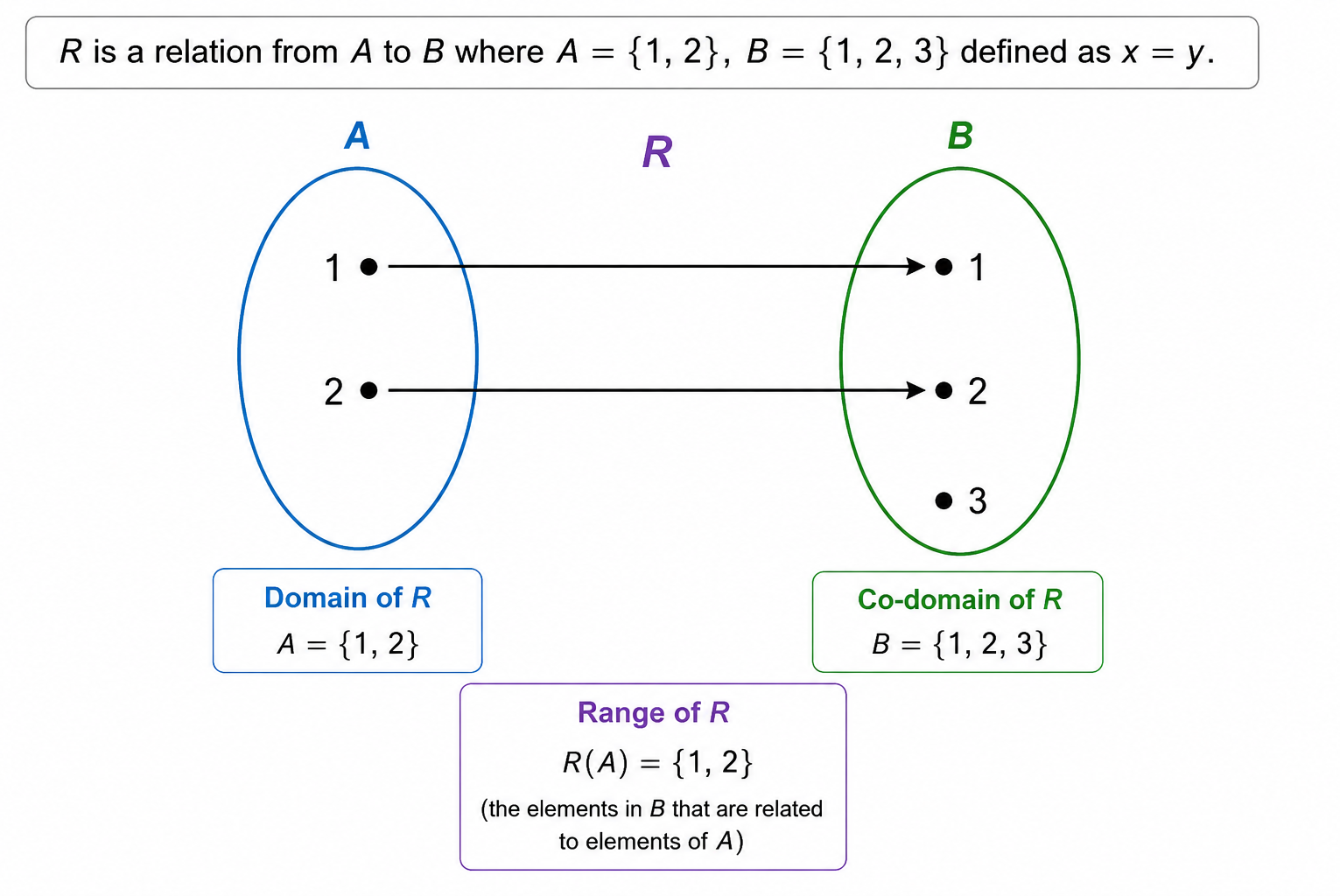
Domain of R
The set of all first elements (antecedents) from the ordered pairs that belong to the relation.
Range of R
The set of all second elements (consequents) from the ordered pairs that belong to the relation.
Co-domain of R
If \(R\) is a relation defined from set A to B and \(R \subset A\times B\), then set B is called the co-domain of relation \(R\).
Example: If \( R = \{(1,1),\;(2,2),\;(3,3)\} \)
- Domain of R \(= \{1,\;2,\;3\}\)
- Range of R \(= \{1,\;2,\;3\}\)
If \(R\) is a relation from set \(A\) to set \(B\), then the inverse relation of \(R\), denoted by \(R^{-1}\), is obtained by reversing the ordered pairs.
If \((a,b) \in R\) then \((b,a) \in R^{-1}\)
Mathematical Form:
Let \( R = \{(1,2),\ (2,3),\ (4,5)\} \)
Then \( R^{-1} = \{(2,1),\ (3,2),\ (5,4)\} \)
\( A \times B = \{(1,1),(1,2),(2,1),(2,2),(3,1),(3,2)\} \).
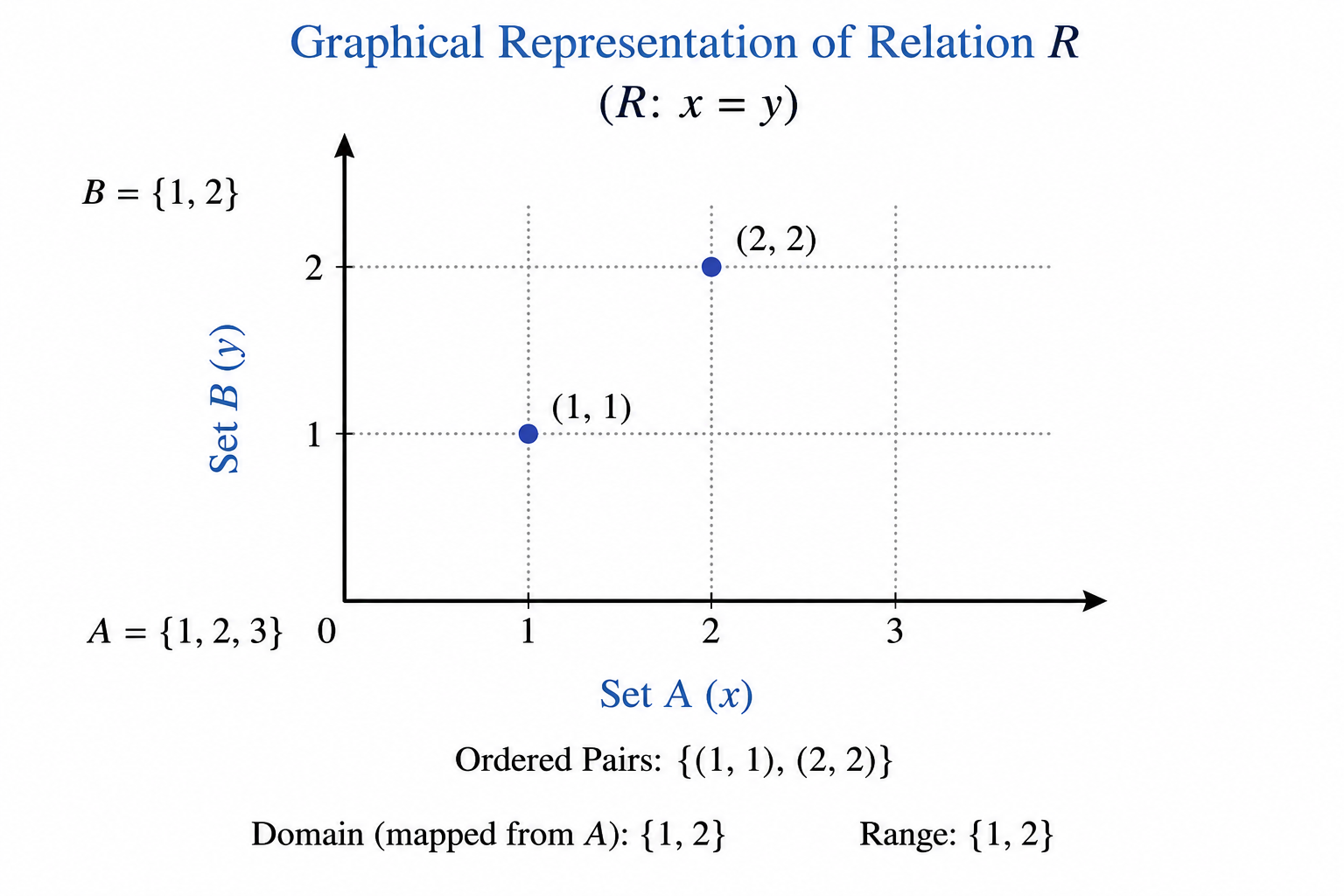
Define relation \( R \) as "Is equal to".
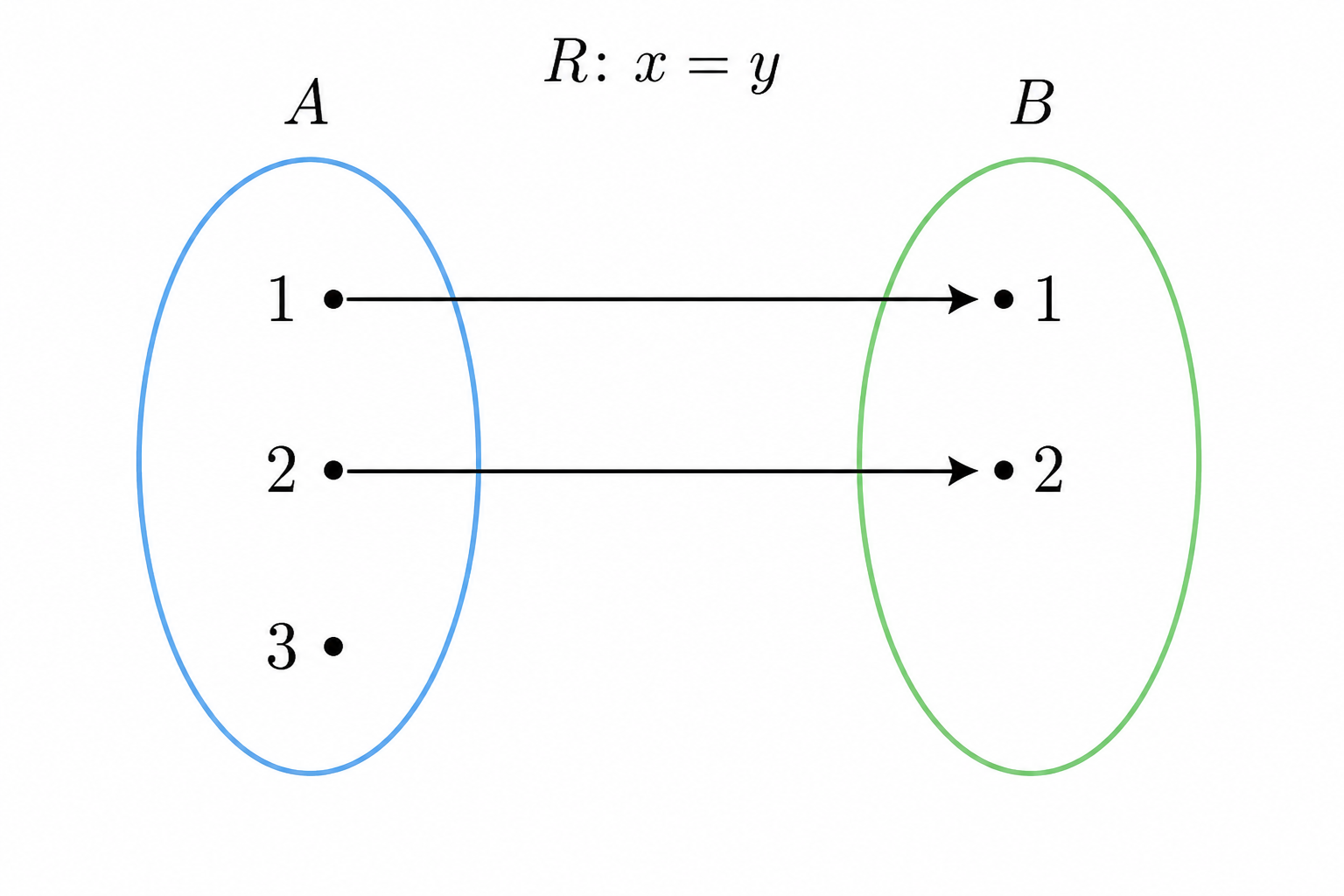
| \( x \) | 1 | 2 |
|---|---|---|
| \( y \) | 1 | 2 |
\( A \times A = \{(1,1),(1,2),(1,3),(2,1),(2,2),(2,3),(3,1),(3,2),(3,3)\} \)
Reflexive Relation
A relation which contains ordered pairs \((x,y)\) such that for all \((x,y) \in R\), either \((x,x) \in R\) or \((y,y) \in R\).
Every element relates to itself.
Symmetric Relation
A relation which contains ordered pairs \((x,y)\) such that for all \((x,y) \in R\), \((y,x) \in R\).
If a relates to b, then b relates to a.
Transitive Relation
A relation where for all \((x,y) \in R\) and \((y,z) \in R\), we have \((x,z) \in R\).
If a → b and b → c, then a → c.
A relation \(R\) is said to be an Equivalence Relation if and only if it is simultaneously:
- Reflexive
- Symmetric
- Transitive
Example: \( R = \{(1,1),\;(1,2),\;(2,1),\;(2,3),\;(1,3)\} \)
Course material curated by Mr. Nripendraswar Acharya