New Millennium Academy
CDC Model Question 2083 – Grade 10 Optional Mathematics
(a) By the Factor Theorem, \(f(x) = x - 1\) is a factor of \(p(x)\) if \(p(1) = 0\).
Verification: \(p(1) = 1^3 - 6(1)^2 + 11(1) - 6 = 1 - 6 + 11 - 6 = 0\). Hence, it is a factor.
(b) By Rational Root Theorem, possible rational roots are \(\pm1, \pm2, \pm3, \pm6\) (factors of the constant term 6 divided by factors of leading coefficient 1).
Testing yields the actual roots as \(x = 1, 2, 3\).
(a) \(f(g(x)) = g(x) + 1 = (x^2 - 5x + 6) + 1 = x^2 - 5x + 7\).
(b) \(g(x) = x^2 - 5x + 6\)
\(= (x - \frac{5}{2})^2 - \frac{25}{4} + \frac{24}{4}\)
\(= (x - \frac{5}{2})^2 - \frac{1}{4}\)
Here, \(h = \frac{5}{2}\) and \(k = -\frac{1}{4}\).
(c) The basic parabola \(y = x^2\) is shifted right by \(\frac{5}{2}\) units and shifted down by \(\frac{1}{4}\) units to obtain \(g(x)\).
(a) \(A^T = \begin{pmatrix}2 & 1\\1 & 3\end{pmatrix}\) (Since A is symmetric).
(b) \(\text{Det}(A) = (2)(3) - (1)(1) = 5\).
\(A^{-1} = \frac{1}{5} \begin{pmatrix}3 & -1\\-1 & 2\end{pmatrix} = \begin{pmatrix}3/5 & -1/5\\-1/5 & 2/5\end{pmatrix}\).
(c) Graphing Instructions: Plot the lines \(2x + y = 8\) (passes through (4,0) and (0,8)) and \(x + 3y = 9\) (passes through (9,0) and (0,3)). The feasible region satisfying all inequalities is the quadrilateral bounded by the vertices \((0,0)\), \((4,0)\), \((3,2)\), and \((0,3)\). Shade this enclosed area.
(a) Given \(\sin(A + B) = \sin A\cos B + \cos A\sin B\). Put \(B = A\):
\(\sin(2A) = \sin A\cos A + \cos A\sin A = 2\sin A\cos A\).
(b) Divide numerator and denominator by \(\cos^2 A\):
\(\sin 2A = \frac{2\sin A\cos A}{\sin^2 A + \cos^2 A} = \frac{2(\sin A/\cos A)}{(\sin^2 A/\cos^2 A) + 1} = \frac{2\tan A}{1 + \tan^2 A}\).
(a) Diagram Description: Draw a vertical line for the cliff of height 100m. From the top, draw two lines of sight to the ground making \(60^\circ\) and \(45^\circ\) with the horizontal. The distances from the foot of the cliff to the points are \(x_1\) (for \(60^\circ\)) and \(x_2\) (for \(45^\circ\)).
(b) \(\tan 60^\circ = \frac{100}{x_1} \Rightarrow x_1 = \frac{100}{\sqrt{3}}\) m.
\(\tan 45^\circ = \frac{100}{x_2} \Rightarrow x_2 = 100\) m.
Distance between points \(= x_2 - x_1 = 100 - \frac{100}{\sqrt{3}} = 100 \left(1 - \frac{1}{\sqrt{3}}\right) = 100 \left(\frac{\sqrt{3} - 1}{\sqrt{3}}\right) \approx 42.26\) m.
(a) \(2\cos A\cos B = \cos(A + B) + \cos(A - B)\).
(b) For \(A = B = C = 60^\circ\) (angles of an equilateral triangle):
LHS \(= 3\cos(120^\circ) = 3(-1/2) = -3/2 = -1.5\).
RHS \(= -1 - 4(\cos 60^\circ)^3 = -1 - 4(1/2)^3 = -1 - 4(1/8) = -1 - 0.5 = -1.5\).
Since LHS = RHS, the identity is verified.
(c) The identity is conditional upon \(A + B + C = 180^\circ\) (triangle angles). For \(A = 90^\circ, B = 60^\circ, C = 45^\circ\), the sum is \(195^\circ \neq 180^\circ\), hence it cannot be verified.
(a) The transformation shifts \(x\) by \(-3\) and \(y\) by \(-3\). Translation matrix: \(\begin{pmatrix}-3\\-3\end{pmatrix}\).
(b) Slope of \(L_1\) (\(m_1\)) \(= \frac{6 - 2}{5 - 1} = \frac{4}{4} = 1\).
Line \(L_2: 2x - y + 3 = 0 \Rightarrow y = 2x + 3\). Slope \(m_2 = 2\).
\(\tan\theta = \left|\frac{m_1 - m_2}{1 + m_1 m_2}\right| = \left|\frac{1 - 2}{1 + (1)(2)}\right| = \left|\frac{-1}{3}\right| = \frac{1}{3}\).
(a) \((x - h)^2 + (y - k)^2 = r^2\).
(b) \(x^2 - 6x + 9 + y^2 - 4y + 4 = 12 + 9 + 4\)
\((x - 3)^2 + (y - 2)^2 = 25\).
Centre \((h, k) = (3, 2)\), Radius \(r = 5\).
(c) The centre \(C\) is \((3, 2)\) and point \(P\) is \((8, 2)\).
Using two-point form: \(\frac{y - 2}{x - 8} = \frac{2 - 2}{3 - 8} = 0 \Rightarrow y - 2 = 0 \Rightarrow y = 2\).
Equation of radius: \(y = 2\).
(a) Reflection in Y-axis changes \((x, y)\) to \((-x, y)\).
\(R(A) = (-2, 1)\) and \(R(B) = (-6, 3)\).
Translation \(T\) adds \(\begin{pmatrix}3\\2\end{pmatrix}\).
\(A' = R(A) + T = (-2+3, 1+2) = (1, 3)\).
\(B' = R(B) + T = (-6+3, 3+2) = (-3, 5)\).
(b) Graphing: Plot \(A(2, 1)\) and \(B(6, 3)\). Then plot \(A'(1, 3)\) and \(B'(-3, 5)\). Draw the original line segment and the transformed line segment on the same graph.
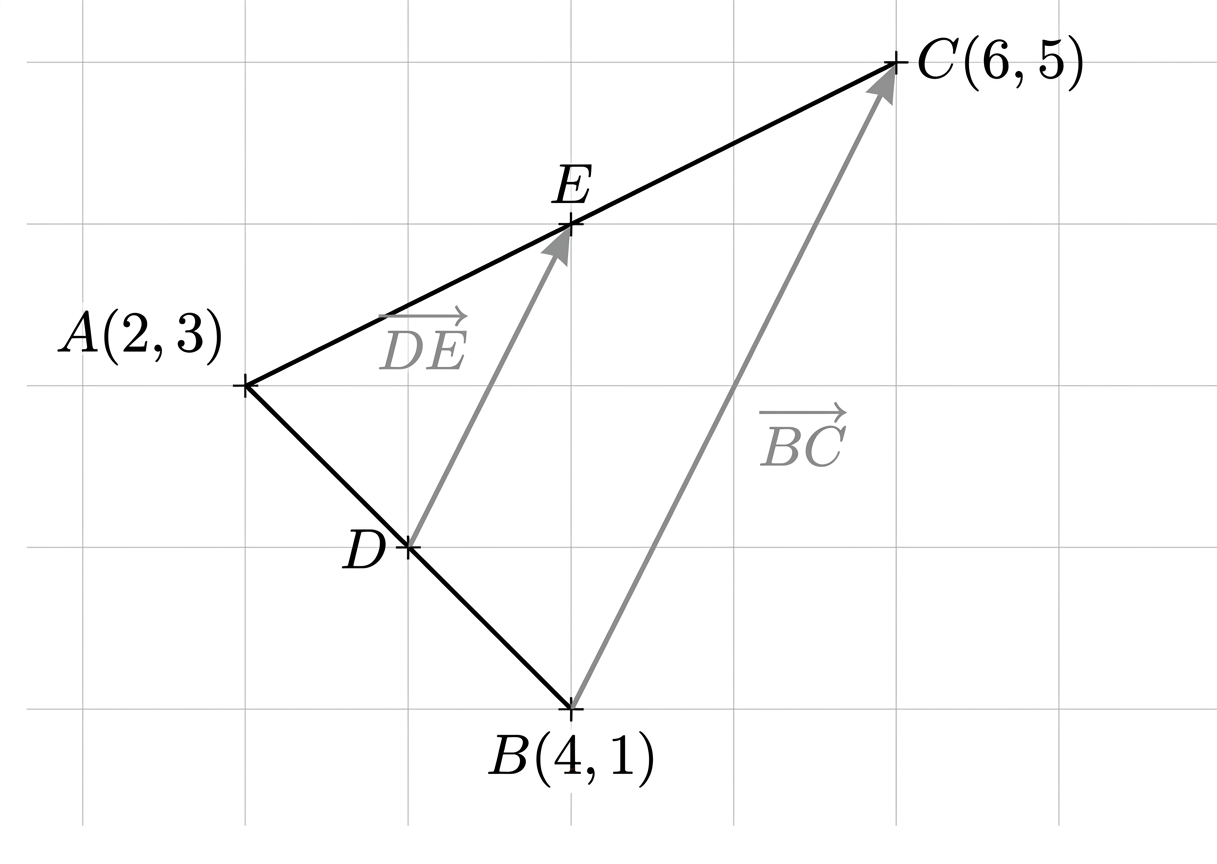
(a) \(\vec{OD} = \frac{1}{2}(\vec{OA} + \vec{OB})\).
(b) \(\vec{OA} = 2\vec{i} + 3\vec{j}\) and \(\vec{OB} = 4\vec{i} + \vec{j}\).
\(\vec{OD} = \frac{1}{2}((2+4)\vec{i} + (3+1)\vec{j}) = 3\vec{i} + 2\vec{j}\).
(c) \(\vec{OE} = \frac{1}{2}(\vec{OA} + \vec{OC}) = \frac{1}{2}((2+6)\vec{i} + (3+5)\vec{j}) = 4\vec{i} + 4\vec{j}\).
\(\vec{DE} = \vec{OE} - \vec{OD} = (4-3)\vec{i} + (4-2)\vec{j} = \vec{i} + 2\vec{j}\).
\(\vec{BC} = \vec{OC} - \vec{OB} = (6-4)\vec{i} + (5-1)\vec{j} = 2\vec{i} + 4\vec{j} = 2(\vec{i} + 2\vec{j})\).
Therefore, \(\vec{DE} = \frac{1}{2}\vec{BC}\). Proved.
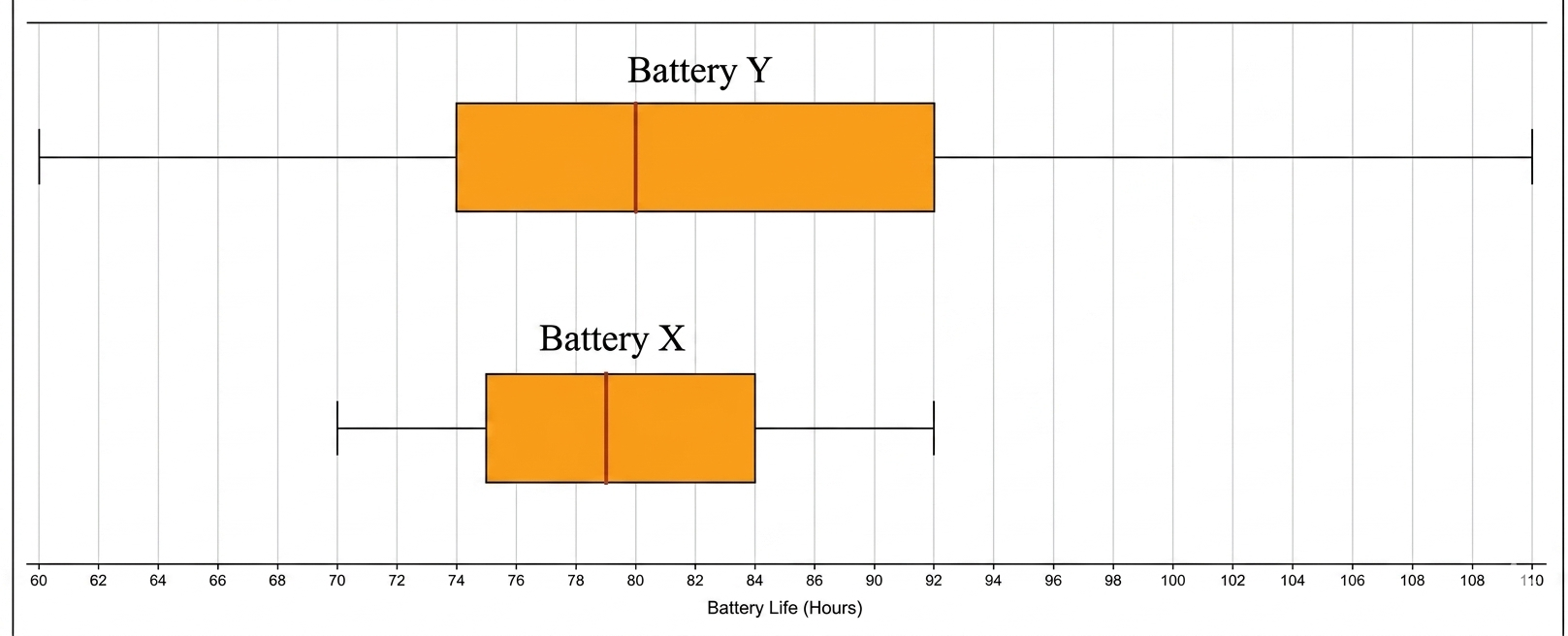
(a) Battery Y has a higher median battery life.
(b) Formula: \(\text{Coeff. of Q.D.} = \frac{Q_3 - Q_1}{Q_3 + Q_1}\).
Based on typical values from the plot for Battery X (approx \(Q_1 = 73\), \(Q_3 = 84\)):
\(\text{Coeff. of Q.D.} = \frac{84 - 73}{84 + 73} = \frac{11}{157} \approx 0.07\).
(c) Battery X is recommended. It has a lower coefficient of variation (tighter spread), which guarantees more consistent and predictable performance, crucial for a remote signal tower.
(a) A function is continuous at a point if its left-hand limit (LHL), right-hand limit (RHL), and the functional value at that point are all equal.
(b) \(\lim_{x \to 3^-} p(x) = 2(3) + 1 = 7\).
\(\lim_{x \to 3^+} p(x) = 3 + 4 = 7\).
Hence, \(\lim_{x \to 3} p(x) = 7\).
(c) \(p(3) = 2(3) + 1 = 7\) (since 3 falls in the interval \(1 \leq x \leq 3\)).
(d) Yes, \(p(x)\) is continuous at \(x = 3\) because \(\lim_{x \to 3} p(x) = p(3) = 7\).
(a) \(M \cdot \vec{O} = \begin{pmatrix}0\\0\end{pmatrix} \Rightarrow O' = (0,0)\).
\(M \cdot \vec{A} = \begin{pmatrix}0 & 1\\1 & 2\end{pmatrix}\begin{pmatrix}1\\0\end{pmatrix} = \begin{pmatrix}0\\1\end{pmatrix} \Rightarrow A' = (0,1)\).
\(M \cdot \vec{B} = \begin{pmatrix}0 & 1\\1 & 2\end{pmatrix}\begin{pmatrix}1\\1\end{pmatrix} = \begin{pmatrix}1\\3\end{pmatrix} \Rightarrow B' = (1,3)\).
(b) \(A(1,0)\) to \(B(1,1)\) is a vertical line \(x=1\). The altitude from \(O(0,0)\) is perpendicular to \(x=1\), meaning it is a horizontal line \(y=0\). The slope is \(0\).
(c) \(\text{Det}(M) = 0(2) - 1(1) = -1 \neq 0\). So, \(M\) is not singular. To make it singular, change any of the 1's to 0 so that \(\text{Det} = 0\). For example, \(M' = \begin{pmatrix}0 & 0\\1 & 2\end{pmatrix}\).
(d) Agree. \(M\) is a symmetric matrix (\(M = M^T\)). Therefore, multiplying by \(M\) or \(M^T\) yields identical results (e.g., for point \(A(1,0)\), both give \(A'(0,1)\)).
(a) Ellipse.
(b) Let \(O\) be the centre of diameter \(AC\). Then \(|OA|=|OB|=|OC|=r\) and \(\vec{OA} = -\vec{OC}\).
\(\vec{AB} = \vec{OB} - \vec{OA}\) and \(\vec{CB} = \vec{OB} - \vec{OC}\).
\(\vec{AB} \cdot \vec{CB} = (\vec{OB} - \vec{OA}) \cdot (\vec{OB} - \vec{OC}) = |\vec{OB}|^2 - \vec{OB}\cdot\vec{OC} - \vec{OA}\cdot\vec{OB} + \vec{OA}\cdot\vec{OC}\).
Substitute \(\vec{OC} = -\vec{OA}\):
\(= |\vec{OB}|^2 + \vec{OB}\cdot\vec{OA} - \vec{OA}\cdot\vec{OB} - |\vec{OA}|^2 = r^2 - r^2 = 0\).
Since the dot product is 0, \(\angle ABC = 90^\circ\). Proved.
(c) No. If \(B\) is inside, \(|OB| < r\). The dot product becomes negative (\(|OB|^2 - |OA|^2 < 0\)), meaning the angle becomes obtuse (greater than \(90^\circ\)).
(d) Given \((AB)^2 + (BC)^2 = (AC)^2 \Rightarrow \sqrt{x+9} + \sqrt{x} = 3^2 = 9\).
\(\sqrt{x+9} = 9 - \sqrt{x}\). Squaring both sides:
\(x + 9 = 81 - 18\sqrt{x} + x \Rightarrow 18\sqrt{x} = 72 \Rightarrow \sqrt{x} = 4 \Rightarrow x = 16\).
(a) \(m = \frac{\cos\theta - \cos 3\theta}{\sin 3\theta - \sin\theta}\).
Using identities: \(\cos\theta - \cos 3\theta = 2\sin 2\theta \sin\theta\) and \(\sin 3\theta - \sin\theta = 2\cos 2\theta \sin\theta\).
\(m = \frac{2\sin 2\theta \sin\theta}{2\cos 2\theta \sin\theta} = \frac{\sin 2\theta}{\cos 2\theta} = \tan 2\theta\). Proved.
(b) \(\tan 2\theta = \frac{2\tan\theta}{1 - \tan^2\theta} = \frac{2(1/3)}{1 - (1/3)^2} = \frac{2/3}{8/9} = \frac{2}{3} \times \frac{9}{8} = \frac{3}{4}\). So, \(m = 0.75\).
(c) \(y = mx + 50 \Rightarrow x = \frac{y - 50}{m}\). Thus, \(f^{-1}(x) = \frac{x - 50}{m}\).
For height \(150\) m: \(f^{-1}(150) = \frac{150 - 50}{3/4} = \frac{100 \times 4}{3} = \frac{400}{3} \approx 133.33\) metres.
(d) Disagree. If \(\theta = 15^\circ\), then \(2\theta = 30^\circ\) and slope \(m = \tan 30^\circ \approx 0.577\).
If angle doubles to \(60^\circ\), new slope \(= \tan 60^\circ \approx 1.732\).
Clearly, \(1.732 \neq 2 \times 0.577\). The slope does not double.
(a) Mean (\(\bar{x}\)) \(= \frac{\sum fm}{\sum f} = \frac{(100\times20) + (300\times30) + (500\times40) + (700\times10)}{100} = \frac{38000}{100} = 380\).
\(\sum fm^2 = 20(100)^2 + 30(300)^2 + 40(500)^2 + 10(700)^2 = 17,800,000\).
\(\sigma = \sqrt{\frac{\sum fm^2}{N} - \bar{x}^2} = \sqrt{178000 - 380^2} = \sqrt{33600} \approx 183.30\).
\(\text{CV} = \frac{\sigma}{\bar{x}} \times 100\% = \frac{183.30}{380} \times 100\% \approx 48.24\%\).
(b) Yes, \(s(k) = 10k^2 - 76k + 178\) is a polynomial function, hence continuous for all real numbers \(k\).
(c) Check limit from the formula: \(s(3.8) = 10(3.8)^2 - 76(3.8) + 178 = 144.4 - 288.8 + 178 = 33.6\).
However, the problem states \(s(3.8) = 30\). Since the calculated limit (\(33.6\)) does not equal the defined value (\(30\)), \(s(k)\) is discontinuous at \(k = 3.8\).