Group ‘A’ — Multiple Choice Questions 1×11 = 11
A When solving \(ax^2 + bx + c = 0\) graphically, the real roots correspond to [1]
B If \(f(x) = 3x - 2\), which one of the following is true? [1]
C Which of the following is the value of \(\cos 20^\circ + \cos 40^\circ\)? [1]
D Which of the following correctly expresses \(\sin(A + B)\)? [1]
E What happens to the angle of elevation when an observer moves closer to a tall tree? [1]
F The equation \(x^2 + y^2 = 49\) represents a circle. What is its diameter? [1]
G Two lines are perpendicular. If one line has slope \(m\), the slope of the other is [1]
H Two reflections are performed successively in \(y = x\) and \(x = 0\). Which point is invariant under the combined transformation? [1]
I If the scalar product of two non-zero vectors is zero, the angle between them is [1]
J A function \(f(x)\) has equal left-hand and right-hand limits at \(x = a\), but \(f(a)\) is not defined. At \(x = a\) the function is [1]
K A higher Coefficient of Variation (CV) indicates: [1]
Group ‘B’ — Subjective Questions 64 Marks
2. The function \(f(x) = x - 1\) and a polynomial \(p(x) = x^3 - 6x^2 + 11x - 6\) are given.
- (a)Write the condition for \(f(x)\) to be a factor of \(p(x)\).[1]
- (b)Use the rational root theorem to determine the possible roots of \(p(x)\).[1]
3. Given \(f(x) = x + 1\) and \(g(x) = x^2 - 5x + 6\).
- (a)Find the composite function \(f(g(x))\).[1]
- (b)Convert \(g(x)\) into vertex form \(y = (x - h)^2 + k\).[1]
- (c)Describe the combined transformation to turn \(y = x^2\) into \(g(x)\).[2]
4. Matrices \(A = \begin{pmatrix}2 & 1\\1 & 3\end{pmatrix}\) and \(B = \begin{pmatrix}a\\b\end{pmatrix}\) are given.
- (a)Find \(A^T\).[1]
- (b)Find \(A^{-1}\).[1]
- (c)The constraints are \(2x + y \leq 8\), \(x + 3y \leq 9\), \(x \geq 0\), \(y \geq 0\). Show the feasible region on a graph.[2]
5. Given \(\sin(A + B) = \sin A\cos B + \cos A\sin B\).
- (a)How can you convert this into \(\sin 2A = 2\sin A\cos A\)?[1]
- (b)If \(\sin 2A = 2\sin A\cos A\), show that \(\sin 2A = \dfrac{2\tan A}{1 + \tan^2 A}\).[1]
6. From the top of a cliff of height 100 m, two points on the same straight line on the ground are observed with angles of depression 60° and 45°.
- (a)Draw a labelled diagram.[1]
- (b)Find the distance between the two points.[2]
7. Given a conditional identity:
\[\cos 2A + \cos 2B + \cos 2C = -1 - 4\cos A\cos B\cos C\]
- (a)Write \(2\cos A\cos B\) in terms of sum or difference.[1]
- (b)Verify the identity for \(A = B = C = 60^\circ\).[2]
- (c)Why can the identity not be verified for \(A = 90^\circ, B = 60^\circ, C = 45^\circ\)?[1]
8. A line \(L_1\) passes through \(A(1, 2)\) and \(B(5, 6)\).
- (a)Write the matrix that transforms \(A(1, 2)\) into \(A'(-2, -1)\).[1]
- (b)\(L_1\) makes an acute angle \(\theta\) with \(L_2 : 2x - y + 3 = 0\). Find \(\tan\theta\).[2]
9. \(x^2 + y^2 - 6x - 4y - 12 = 0\) is a circle.
- (a)Write the equation of a circle with centre \((h, k)\) and radius \(r\).[1]
- (b)Find the centre and radius of the given circle.[2]
- (c)Use the two-point formula to find the equation of the radius through point \(P(8, 2)\) on the circle.[2]
10. Points \(A(2, 1)\) and \(B(6, 3)\).
- (a)Apply the combined transformation \(T \circ R\) where \(R\) is reflection in the \(Y\)-axis and \(T\) is translation by \(\begin{pmatrix}3\\2\end{pmatrix}\). Find the images of \(A\) and \(B\).[2]
- (b)Plot the object and final image on the same graph paper.[1]
11. Triangle \(ABC\) has vertices \(A(2, 3)\), \(B(4, 1)\), \(C(6, 5)\). \(D\) and \(E\) are midpoints of \(AB\) and \(AC\).

- (a)Write the position vector of \(D\) in terms of \(A\) and \(B\).[1]
- (b)Find the position vector of \(D\) in \(\vec{i},\,\vec{j}\) form.[1]
- (c)Prove by vector method: \(\overrightarrow{DE} = \dfrac{1}{2}\overrightarrow{BC}\).[1]
12. The box plots below show battery life of Battery \(X\) and Battery \(Y\).
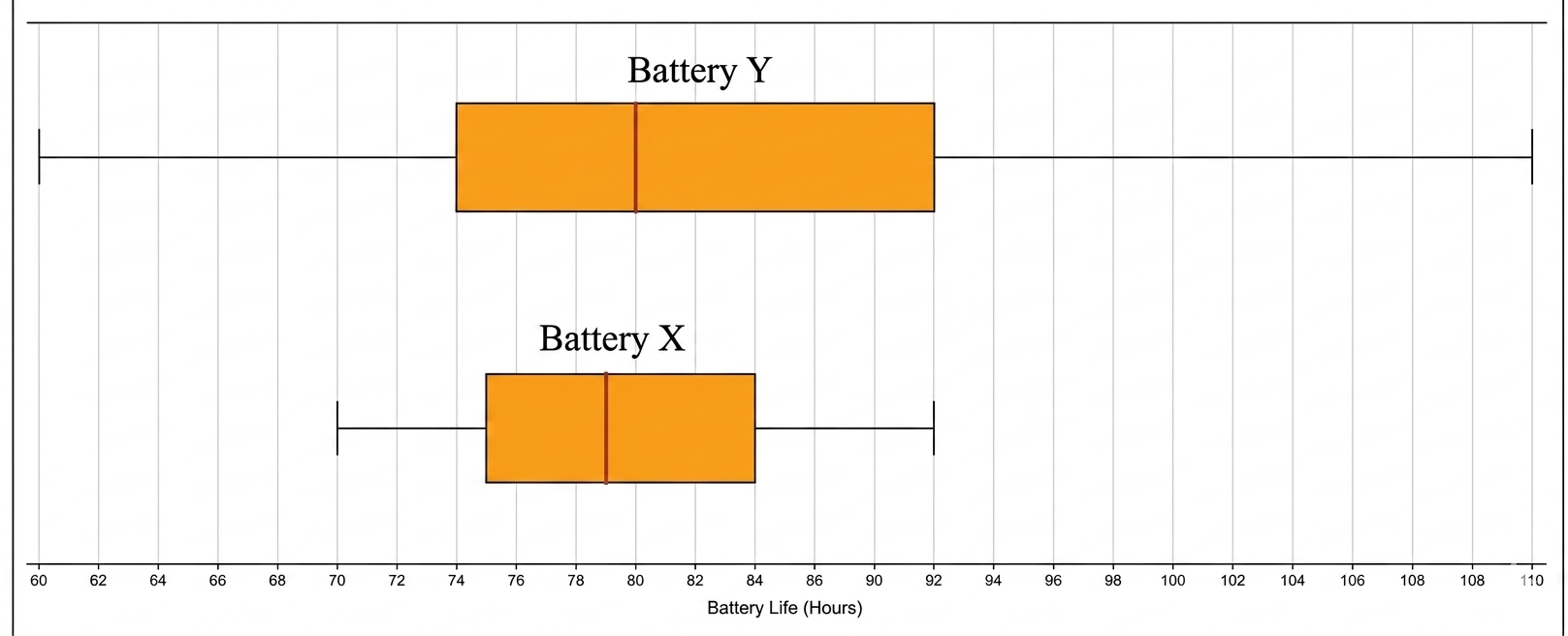
- (a)Which battery has higher median battery life?[1]
- (b)The coefficient of quartile deviation of Battery \(Y\) is 0.098. Calculate that of Battery \(X\).[1]
- (c)Which battery would you suggest for a remote signal tower and why?[1]
13. A function \(p(x)\) is defined as:
\[p(x) = \begin{cases} 2x + 1, & 1 \leq x \leq 3 \\ x + 4, & x > 3 \end{cases}\]
- (a)Define continuity of a function.[1]
- (b)Find \(\displaystyle\lim_{x \to 3} p(x)\).[1]
- (c)Find \(p(3)\).[1]
- (d)Is \(p(x)\) continuous at \(x = 3\)? Justify.[1]
14. Triangle \(OAB\) with \(O(0,0)\), \(A(1,0)\), \(B(1,1)\) and transformation matrix \(M = \begin{pmatrix}0 & 1\\1 & 2\end{pmatrix}\).
- (a)Find the image \(O'A'B'\) under \(M\).[2]
- (b)Find the slope of the altitude from \(O\) to \(AB\).[1]
- (c)Is \(M\) singular? If not, how can you make it singular?[1]
- (d)Dolma claims that \(M\) and \(M^T\) give the same transformation. Do you agree? Justify with an example.[2]
15. Shreya cuts a wooden cone to form a conic section.
- (a)Name the shape when the cut is inclined more than the semi-vertical angle but less than 90°.[1]
- (b)For a semicircle \(ABC\) with diameter \(AC\), prove using vectors that \(\angle ABC = 90^\circ\) for any \(B\) on the arc.[2]
- (c)Would the claim hold if \(B\) lies inside the semicircle? Explain.[1]
- (d)If \((AB)^2 = \sqrt{x+9}\), \((BC)^2 = \sqrt{x}\) and \(AC = 3\) units, find \(x\).[2]
16. A hiker climbs a hill with height \(h = f(x) = mx + 50\) (metres). The slope \(m\) is given by
\[m = \frac{\cos\theta - \cos 3\theta}{\sin 3\theta - \sin\theta}\]
- (a)Prove that \(m = \tan 2\theta\).[2]
- (b)If \(\tan\theta = \dfrac{1}{3}\), find \(m\).[2]
- (c)Using \(f^{-1}(x)\), find the horizontal distance when the hiker is at height 150 m.[2]
- (d)Bina claims: “If the angle with the \(X\)-axis doubles, the slope doubles.” Verify with a specific \(\theta\).[1]
17. A bus stop is to be placed at position \(k\) metres along a road. The table gives population in each section:
| Length (in metre) | Mid value (\(m\)) | Population (\(f\)) |
|---|---|---|
| 0 – 200 | 100 | 20 |
| 200 – 400 | 300 | 30 |
| 400 – 600 | 500 | 40 |
| 600 – 800 | 700 | 10 |
The total squared walking distance is \(s(k) = 10k^2 - 76k + 178\).
- (a)Calculate the coefficient of variation of the residence distribution.[3]
- (b)Is \(s(k)\) continuous for all \(k\)?[1]
- (c)Given \(s(3.8) = 30\), is \(s(k)\) continuous at 3.8?[1]