Instruction: Attempt all questions. Figures in brackets indicate marks and cognitive level — K: Knowledge, U: Understanding, A: Application, HA: Higher Ability.
MCQ (Multiple Choice Questions)1 × 11 = 11
Copy correct option on your answer sheet.
1. If matrix A has 2 rows and 3 columns, matrix B has 1 row and 3 columns, what is the order of matrix A? [1K]
(a) \(3\times2\)
(b) \(2\times3\)
(c) \(1\times3\)
(d) \(2\times1\)
2. If ordered pairs \((x-2,\,5)=(3,\,y+1)\), find the values of 'x' and 'y'. [1A]
(a) \(x=5,\ y=4\)
(b) \(x=1,\ y=4\)
(c) \(x=5,\ y=6\)
(d) \(x=1,\ y=6\)
3. What is the formal definition of \(1°\)? [1K]
(a) \(\dfrac{1}{360}\)th part of a circle.
(b) Angle subtended by a diameter.
(c) \(\dfrac{1}{400}\)th part of a circle.
(d) Angle subtended by an arc equal to the radius.
4. A vehicle wheel turns \(120°\). What is the equivalent angle in the centesimal system? [1A]
(a) \(100^{\text{g}}\)
(b) \(133.33^{\text{g}}\)
(c) \(150^{\text{g}}\)
(d) \(200^{\text{g}}\)
5. The angles of a quadrilateral are in ratio \(1:2:3:4\). What is the largest angle in radians? [1HA]
(a) \(\dfrac{2\pi}{5}\)
(b) \(\dfrac{3\pi}{5}\)
(c) \(\dfrac{4\pi}{5}\)
(d) \(\pi\)
6. The path traced by a moving point under a given geometrical condition is called: [1K]
(a) Coordinates
(b) Axis
(c) Locus
(d) Reflection
7. One end of a diameter of a circle is \((1,4)\), another end is \((3,2)\). The centre of the circle is ______. [1A]
(a) \((2,3)\)
(b) \((3,2)\)
(c) \((-1,1)\)
(d) \((1,-1)\)
8. The final image of point \((2,3)\) when reflected about line \(x=h\) is \((-8,3)\); the line of reflection is ______. [1HA]
(a) \(h=-1\)
(b) \(h=2\)
(c) \(h=-3\)
(d) \(h=-2\)
9. If \(\vec{a}=\binom{2}{-3},\ \vec{b}=\binom{1}{0}\) then \(\vec{a}+2\vec{b}\) is ______. [1U]
(a) \(\binom{4}{-3}\)
(b) \(\binom{-4}{3}\)
(c) \(\binom{0}{3}\)
(d) \(\binom{3}{0}\)
10. In the given data, \(10, 20, 30, 40, 50, 60, 70, 80\) the position of second quartile is the \(4.5^{\text{th}}\) item. \(Q_2\) is ______. [1U]
(a) \(40\)
(b) \(50\)
(c) \(55\)
(d) \(45\)
11. For a sequence defined by \(t_n=\dfrac{1}{n}\), what does \(\displaystyle\lim_{n\to\infty} t_n\) equal? [1U]
(a) \(1\)
(b) \(-1\)
(c) \(0\)
(d) \(\infty\)
WCA (Within Content Area)40 marks
12. A local fruit vendor sells apples, banana and mangos. Let set
\(F=\{\text{Apple, Banana, Mango}\}\) and cost set
\(P=\{\text{Rs }320,\ \text{Rs }220,\ \text{Rs }120\}\).
(a)Define Cartesian Product. [1K]
(b)Write down the Cartesian product \(F\times P\). [1U]
(c)The relation between fruits and cost per kg is given as, \(R=\{(\text{Apple},320),(\text{Banana},220),(\text{Mango},120)\}\). Find the domain and range of R. [1A]
13. NMA administration is mapping students to bus routes. Let the relation created be, \(R=\{(1,1),(1,2),(2,1),(2,2),(3,1),(3,2),(3,3),(2,3),(1,3)\}\).
(a)Write a relation \(R_1\) for reflexive relation. [1K]
(b)Show relation \(R_2\) defined as "is equal to" in an arrow diagram. [1A]
(c)Prove, with reason, whether the given relation R is an equivalence relation. [2HA]
14. The school library tracks Maths books using matrix \(M=\begin{pmatrix}2 & 3\\ 4 & 1\end{pmatrix}\) and Science books using matrix \(S=\begin{pmatrix}1 & 5\\ 0 & 2\end{pmatrix}\).
(a)Find \(m_{12}+s_{22}\). [1U]
(b)If the Nepali books are denoted by matrix N, then find the matrix for Nepali books if \(2M+N=S\). [2A]
15. The triangular flag of Nepal features unique geometric properties. A designer measures one specific angle as \(30^{\text{g}}\) and the ratio of the remaining two angles is \(1:2\).
(a)State the relationship between the Sexagesimal and Centesimal systems. [1K]
(b)Convert \(30^{\text{g}}\) into degree. [1U]
(c)Calculate the remaining angles in degree. [2A]
16. A Himalayan horse in Mustang is tied to a pole in a grazing field with a rope of length \(14\) meters.
(a)Write the formula connecting arc length, radius and central angle. [1K]
(b)If the horse grazes along the boundary and covers a central angle \(\dfrac{\pi^{\text{c}}}{4}\), calculate the distance it walked, keeping the rope tight. [2A]
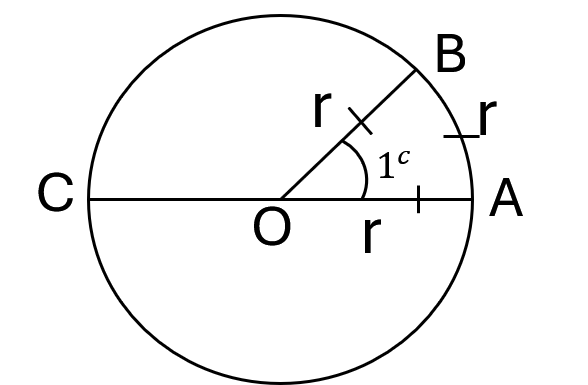
17. A teacher drew a figure on the whiteboard as given alongside, with the following information: \(\angle AOB = 1^{\text{c}}\); \(OA=OB=\text{arc }AB=r\); \(\angle AOC=180°\); \(\text{arc }ABC=\pi r\).
(a)Prove that: \(1^{\text{c}}=\dfrac{180°}{\pi}\). [1HA]
(b)What is the statement of the theorem for the above proved result? [1U]
18. A land survey in Pokhara defines four boundary pillars forming a parallelogram ABCD. Three vertices are \(A(1,2)\), \(B(4,3)\), and \(C(6,6)\).
(a)Define the term Locus. [1K]
(b)Find the mid-point of diagonal AC. [1U]
(c)Using the property of diagonals, find the coordinates of the 4th vertex D. [2A]
19. A traditional Newari window has a wooden strut (थाम) joining \(P(-3,6)\) and \(Q(6,0)\). Artisans need to carve marks that divide this strut into three equal parts.
(a)Write down the Internal Section Formula. [1K]
(b)Find the coordinates of the two points that trisect the segment PQ. [2A]
20. \(\triangle ABC\) has vertices \(A(2,3)\), \(B(4,6)\) and \(C(1,5)\). An architect transforms it for symmetry using the formula \(P(x,y)\longrightarrow P'(-y,-x)\).
(a)Find the transformed coordinates of A, B, C using the given formula. [2U]
(b)Show both triangles \(\triangle ABC\) and \(\triangle A'B'C'\) on the same graph paper. [2A]
21. A trekker walks from a tea house to a bridge, with displacement \(\vec{a}=\binom{3}{4}\). Then she walks to a waterfall, represented by \(\vec{b}=\binom{-1}{2}\).
(a)In a \(\triangle ABC\), state the Triangle Law of Vector Addition. [1K]
(b)Calculate her total displacement from the tea house to the waterfall. [1A]
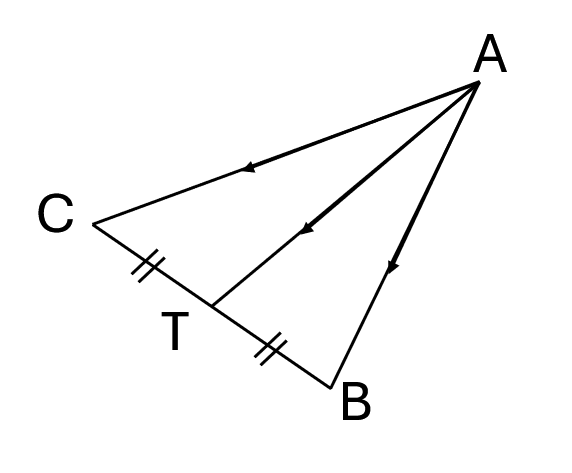
(c)The figure alongside shows the tea house at A, bridge at B and waterfall at C. If temple T is at equal distance from the bridge and the waterfall, then prove that \(\vec{AT}=\dfrac{1}{2}(\vec{AB}+\vec{AC})\). [1HA]
22. The mathematics marks obtained by 7 students are \(40, 45, 55, 60, 70, 75, 80\).
(a)What does a quartile represent in statistics? [1K]
(b)Use the formula and find the first quartile. [1U]
(c)A student who obtained 55 marks actually obtained 85 in retotalling. What effect will be seen in \(Q_1\)? [1HA]
23. Table and calculations for \(f(x)=\dfrac{x^{2}-4}{x-2}\):
(a)What is the approaching value of the sequence \(1.9,\ 1.99,\ 1.999,\ 1.9999,\ \dots\)? [1K]
(b)Copy and complete the table. [1U]
(c)Estimate the value of \(\displaystyle\lim_{x\to 2} f(x)\). [1A]
(d)Why is \(f(2)\) undefined? [1HA]
CCA (Cross Content Area)24 marks
24. A dairy factory in Ilam tracks weekly production. The production state is represented by matrices \(P=\begin{pmatrix}2x+y & 6500\\ 6100 & 7500\end{pmatrix}\) and \(S=\begin{pmatrix}7200 & 6500\\ 6100 & 15y\end{pmatrix}\) respectively. Production and sales are perfectly stable, so \(P=S\). Also, the daily production of milk for 9 days is recorded as: 5550 l, 6000 l, 7200 l, 7500 l, 7500 l, 7600 l, 8000 l, 8200 l, 9000 l.
(a)For what values of 'x' and 'y' will production and sales be perfectly stable? [2A]
(b)Calculate \(P_{37}\), \(Q_3\) from the daily production of milk. [3A]
(c)What is the limit of production of milk in an infinite number of days? [1A]
25. Points \(A(-7,0)\), \(P(x,y)\), \(B(7,0)\) are vertices of \(\triangle APB\).
(a)If \(\triangle APB\) is a right-angled triangle at P, and the difference of the acute angles is \(\left(\dfrac{\pi}{3}\right)^{\text{c}}\), find all angles in degree. [2A]
(b)Find the locus of point \(P(x,y)\) if \(\angle APB\) is always \(90°\). [2HA]
(c)Find the images of points A and B when reflected about the line \(x=2\). [2U]
26. A player's movement in a field is tracked from \(A(4,3)\) to \(B(8,1)\), and from \(C(-2,4)\) to \(D(a,b)\).
(a)If \(\vec{AB}=\vec{CD}\), find the coordinates of point D. [2A]
(b)In what ratio does the point \((x,0)\) divide AB? [1HA]
(c)If point \(A(4,3)\) lies on the locus \(x^{2}+y^{2}+Kx+4y+6=0\), what is the value of 'K'? [1A]
(d)If D represents the number of degrees of an angle and R represents the radian measure of the same angle, prove that \(\dfrac{D}{90}=\dfrac{2R}{\pi}\). [2U]
27. Sita and Gita are discussing different topics of Additional Maths.
Discussion 1: Sita says "\(\infty-\infty\) is 0."
Gita says "\(\infty-\infty\) is undefined."
Discussion 2: Sita says "\(1°-1^{\text{g}}\) is a positive value."
Gita says "\(1^{\text{g}}-1°\) is a positive value."
Discussion 3: Sita says, "Only equal vectors are parallel."
Gita says, "\(\vec{a}=\binom{3}{4}\) and \(\vec{b}=\binom{6}{8}\) are also parallel."
Discussion 4: Sita wrote, \(A\times B=\{(1,a),(2,a),(1,b),(2,b)\}\).
Gita says, \(A\times B\neq B\times A\).
(a)Who is correct in Discussion 1? Explain. [1HA]
(b)Which is positive, \(1°-1^{\text{g}}\) or \(1^{\text{g}}-1°\)? Justify. [1HA]
(c)Are the vectors written by Gita parallel? How? [1HA]
(d)Find \(B\times A\) from Discussion 4. [2U]
(e)Why is Gita correct in Discussion 4? Give your reason. [1HA]
— Do well —